
Behavior-Driven Development: Executable Specifications That Never Go Stale
Behavior-Driven Development is a powerful practice for automated testing — but it is even more an approach for improving collaboration between business and development. The business defines requirements as concrete, business-readable Gherkin scenarios, and development provides the automation that connects those scenarios to the running system through step definitions.
The net result is requirements that are executable and can be proven. Instead of prose that drifts away from reality, the business expresses expected behavior as examples — and every build demonstrates that the system actually follows those rules. Business and technical roles work from a single shared source of truth rather than separate documents that quietly fall out of sync.
A collaborative practice, not just testing
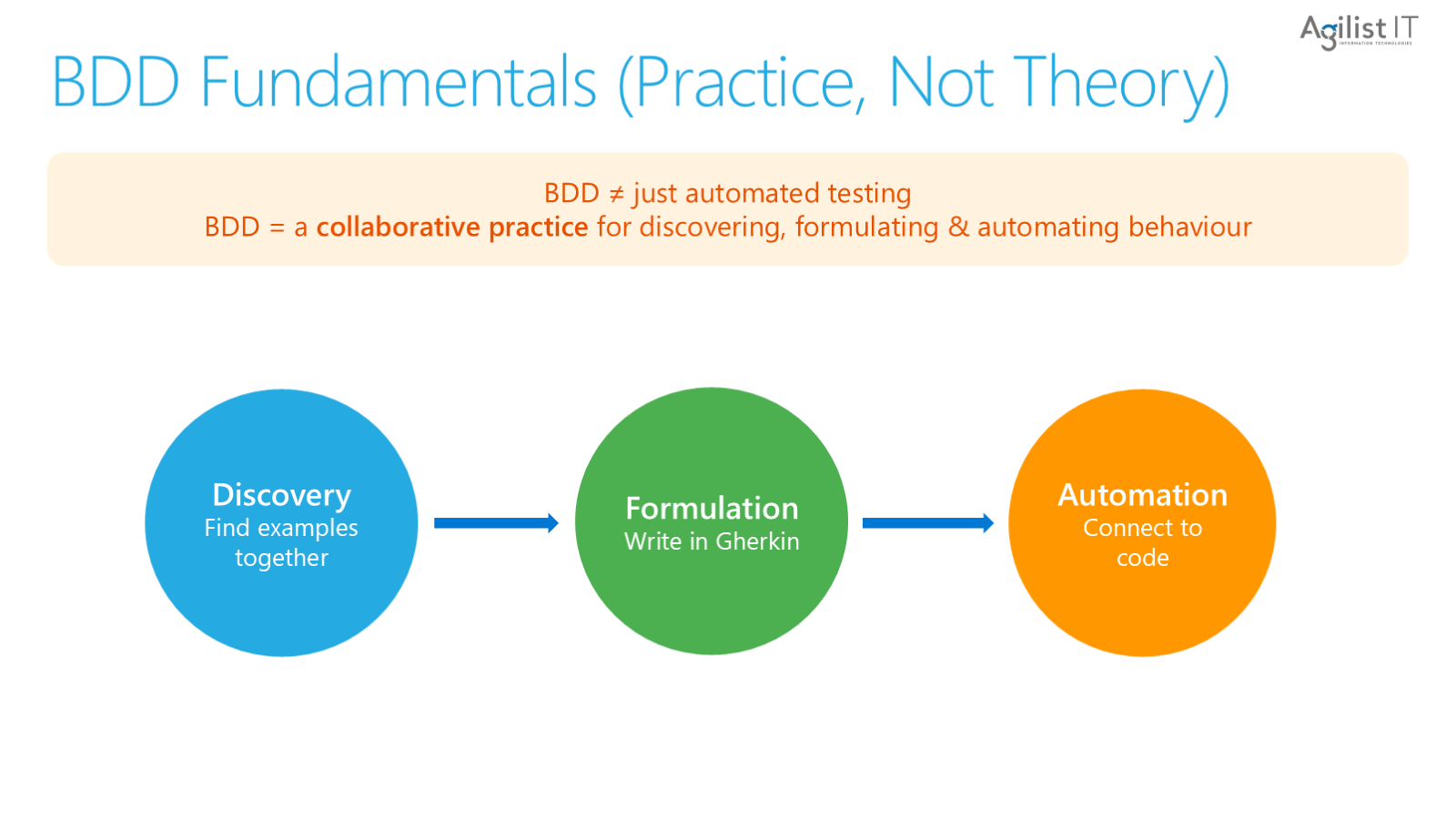
BDD is a collaborative practice for discovering, formulating, and automating the behavior of a system:
- Discovery – explore concrete examples together, with business, development, and testing in the room (the "Three Amigos").
- Formulation – capture those examples as clear Gherkin scenarios that everyone can read.
- Automation – connect the scenarios to code with step definitions so they run on every build.
Instead of "bonus adjustments must be applied correctly", a BDD team asks: "100.00 EUR in 3 installments — what exactly happens?" Whoever cannot answer has just discovered a gap in the requirement — before a single line of code exists.
Why teams adopt BDD
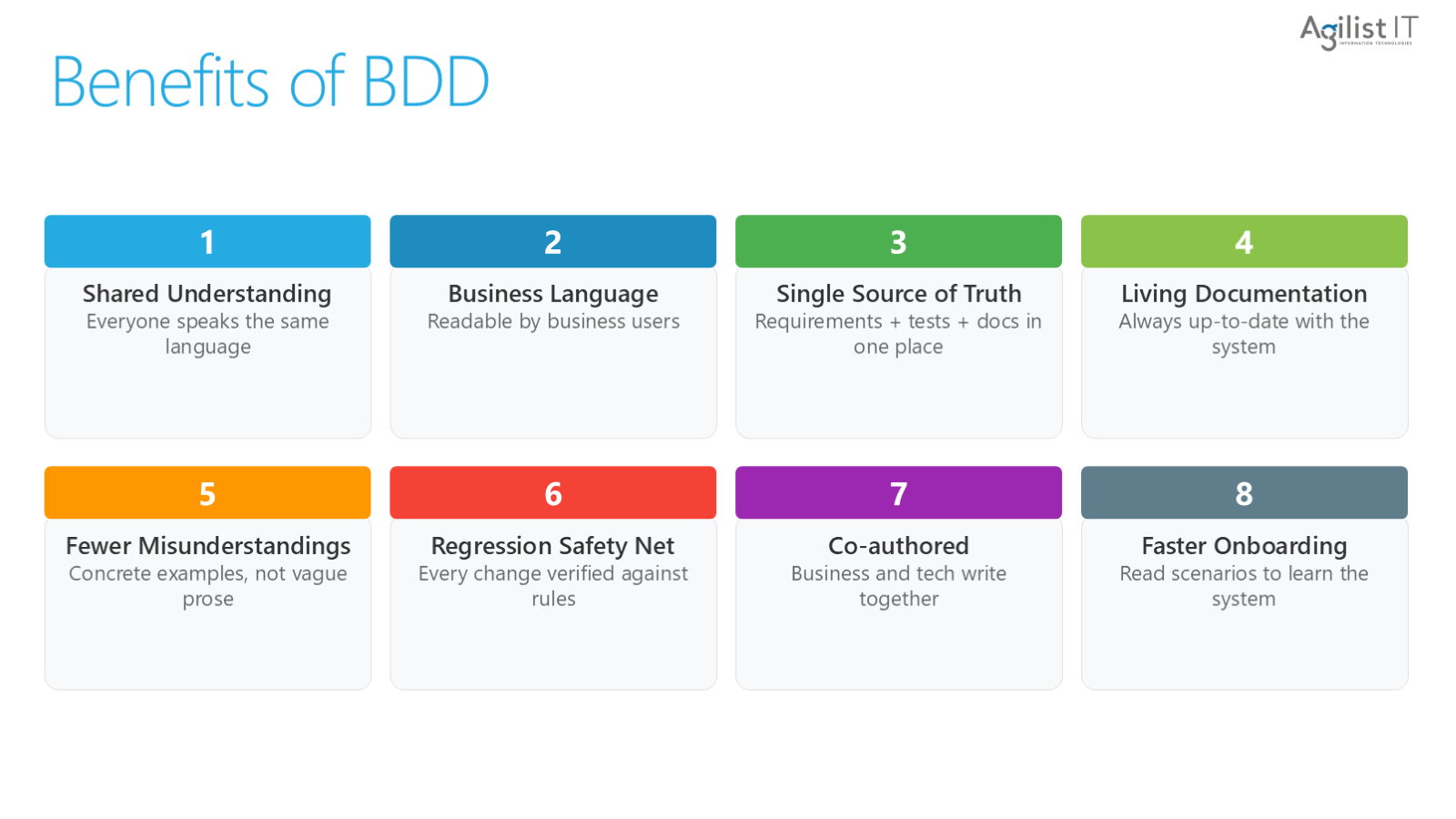
Teams that adopt BDD consistently report the same benefits, regardless of technology stack:
- Shared understanding – everyone speaks the same language.
- Business-readable – scenarios can be read and validated by business users.
- Single source of truth – requirements, tests, and documentation live in one place.
- Living documentation – specifications stay up to date because they run on every build.
- Fewer misunderstandings – concrete examples replace vague prose.
- Regression safety net – every change is verified against the business rules.
- Co-authored – business and technical roles write scenarios together.
- Faster onboarding – new team members read the scenarios to learn the system.
Executable requirements that can be proven
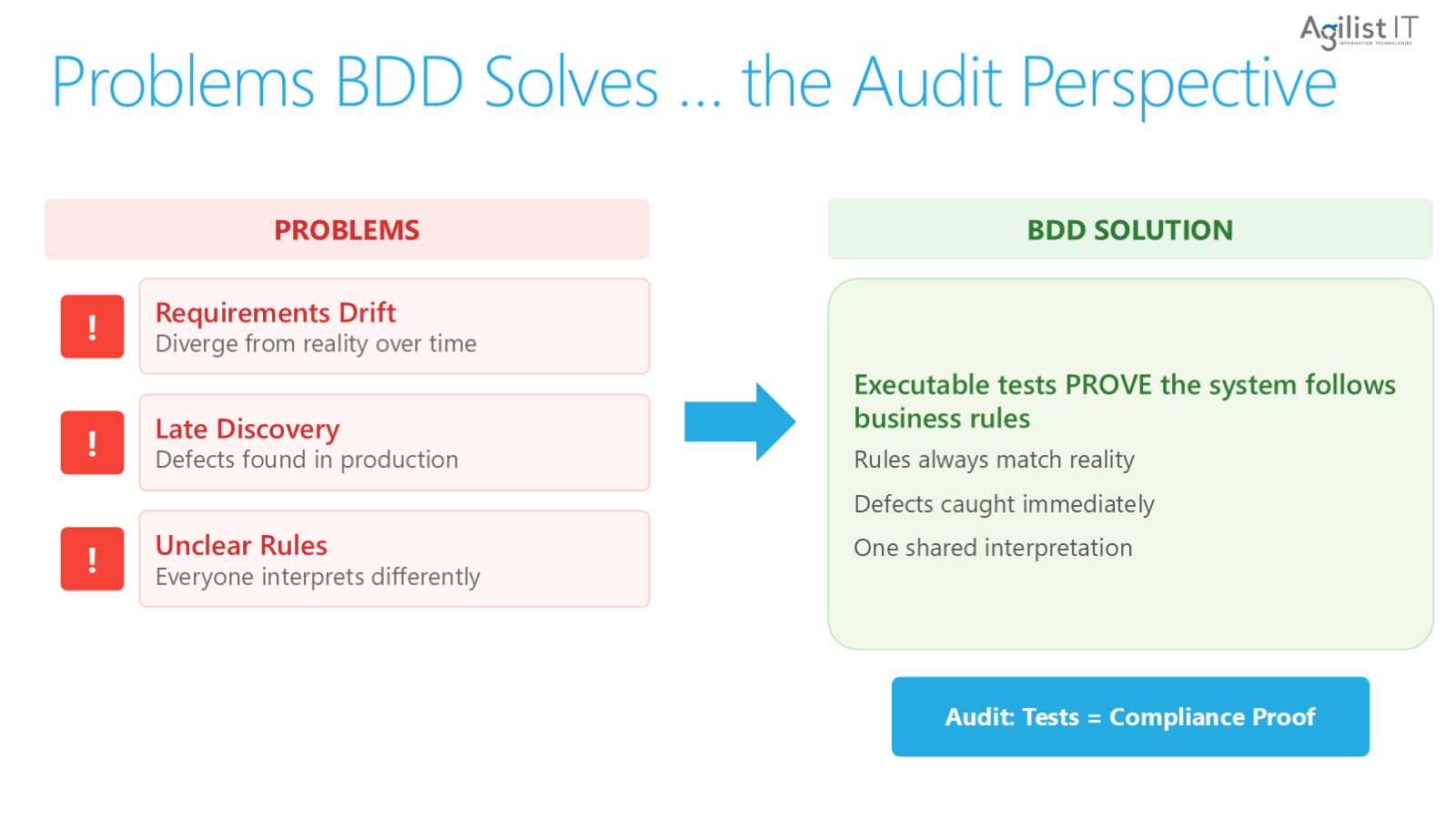
Traditional requirements drift away from reality, defects are discovered late, and rules are interpreted differently by different people. BDD addresses all three at once: because the scenarios are executable, they prove that the system follows the business rules — the rules always match reality, defects are caught immediately, and there is one shared interpretation. From an audit and compliance perspective, passing BDD tests become tangible evidence of conformance.
Step definitions: from Gherkin to running tests
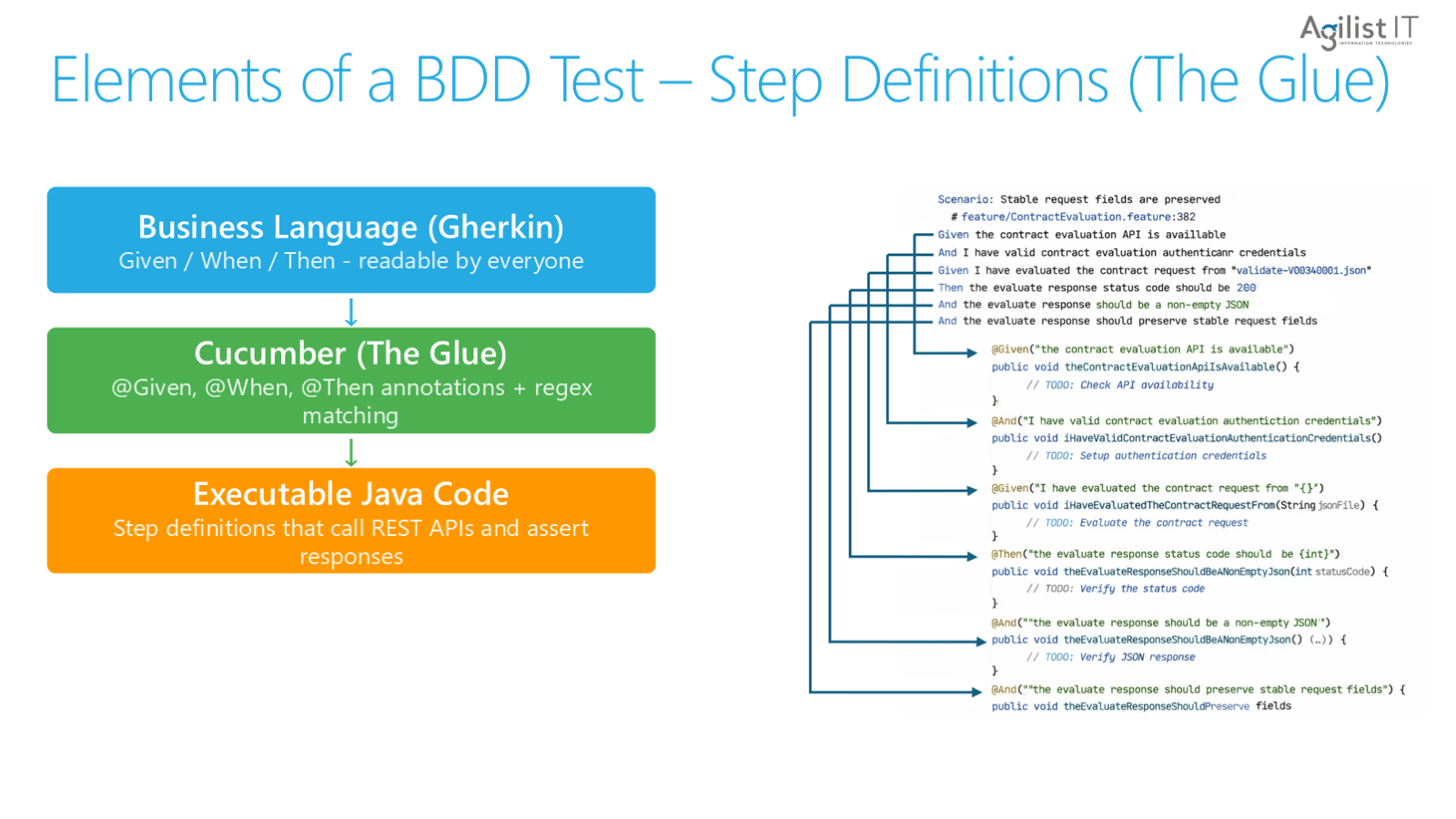
Step definitions are the glue between business-readable scenarios and the code that executes them: the Gherkin phrase ("When I calculate installments with amount…") is bound to a method that calls the system and asserts the result. The same step is written once and reused across many scenarios and feature files — which keeps the suite small, consistent, and fast to extend. It also means business people can extend an automated test suite by composing scenarios from an agreed step vocabulary, without writing code.
What changed: AI removes the labor
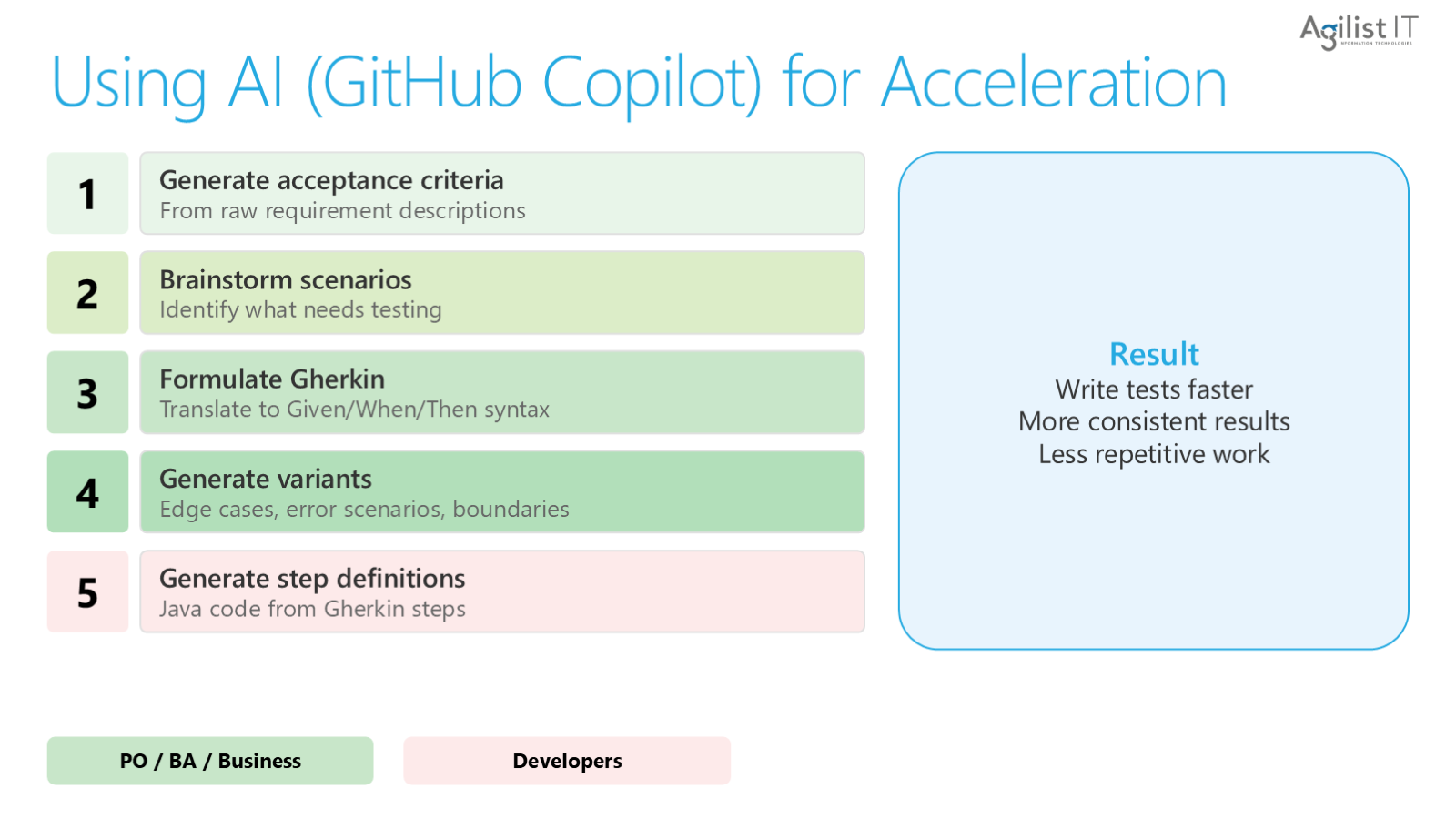
BDD has been right for twenty years — the effort was the barrier. Hand-writing standardized Gherkin and the glue code made many teams give up.
That barrier is falling. With AI-assisted workflows, refined requirements become consistent feature files in minutes, edge cases are brainstormed on demand, and step definitions are generated instead of hand-written — while people stay in control of meaning and validation. AI is an accelerator for BDD, not a replacement for shared understanding, refinement, or collaboration. When scenarios are cheap to write and to run, executable specifications stop being a luxury and become the everyday default.
Grounded in the BDD literature
The approach described here follows the established BDD and specification literature: Specification by Example (Gojko Adzic), BDD in Action (John Ferguson Smart), Writing Great Specifications (Kamil Nicieja), and Discovery & Formulation (Gáspár Nagy and Seb Rose). Across all of these, the same themes recur: collaborate around concrete examples, keep one shared and readable source of truth, and let executable specifications serve as documentation that never goes stale.
Want to experience the whole loop hands-on — from a refined requirement to an executed, documented specification, in one day? See our AI-Powered Behavior-Driven Development Training: half the day in guided labs on a real application, with separate paths for business and technical roles.